
Property buyers don't make decisions overnight. They research, compare, and build trust before making an enquiry. CiberFlo helps Hyderabad builders, developers, and property consultants reach high-intent buyers with integrated digital marketing strategies designed to generate qualified property enquiries and support long-term sales growth.
A generic digital marketing agency optimises for the metrics that matter in many industries: clicks, form fills, and cost per lead. However, real estate requires looking beyond those numbers. What matters is the quality of those leads - whether they have the budget, genuine purchase intent, and are ready to move closer to a buying decision.
The purchase is high-value enough that buyers research extensively before ever contacting anyone.

The sales cycle can run from a few weeks to several months, unlike most digital purchase decisions.

The final decision is rarely made alone — spouses, parents, and sometimes business partners weigh in.

In most digital businesses, the gap between first contact and purchase is minutes or days. In Hyderabad real estate, that gap typically spans four to twelve weeks for ready-to-move inventory, and considerably longer for under-construction premium and luxury projects, where buyers often revisit a project three or four times — physically and digitally — before booking.
One or two touchpoints are usually enough to convert a lead.
Sustained interest across dozens of touchpoints - SEO, Google Ads, retargeting, WhatsApp, email, and automation keep buyers engaged until they're ready to book a site visit.
Residential builders, commercial developers, luxury communities, land developers, realtors, and co-working providers all have different buyers, sales cycles, and growth goals. That's why every strategy we build is tailored to your business model, customer journey, and revenue objectives.

Need launch-phase intensity followed by sustained, steady-state lead generation through possession.


Selling exclusivity and lifestyle first, price second — shifting marketing toward brand-building content.

Sell to investors with longer time horizons, where appreciation data and infrastructure narratives matter more than lifestyle imagery.

Need lead generation and reputation systems scaled to their business size, without the overhead built for a large developer.
Sit closer to a B2B services sale than a real estate sale — shorter cycles, more complex decision-making units.
Hyderabad's real estate market has grown around a small number of demand corridors — HITEC City, Gachibowli, and the Financial District chief among them — where IT and business services employment has pulled residential demand outward into Kokapet, Narsingi, Tellapur, Kondapur, Kompally, and Bachupally. This matters for marketing because Hyderabad buyers rarely search by city. They search by locality — "apartments in Kokapet," "villas near Financial District" — because they've already narrowed their decision to a commute radius before they start comparing developers.
Buyer behaviour in Hyderabad has also shifted decisively toward digital-first research, even though the final steps of a transaction remain heavily offline. A buyer today will compare RERA registration status, builder track record, construction quality signals, and price trends across three or four projects online, long before contacting a sales team or visiting a site.
Trust carries disproportionate weight in this market. RERA compliance, a builder’s delivery history, and visible construction progress often matter more to a Hyderabad buyer than design or amenities, particularly for mid-market and first-time buyers who have seen delayed projects elsewhere in the city.
Mobile behaviour is also worth planning around directly. A large share of research, and a meaningful share of lead-form submissions, happen on mobile devices outside standard business hours — particularly among NRI buyers browsing in different time zones and working professionals researching in the evening.
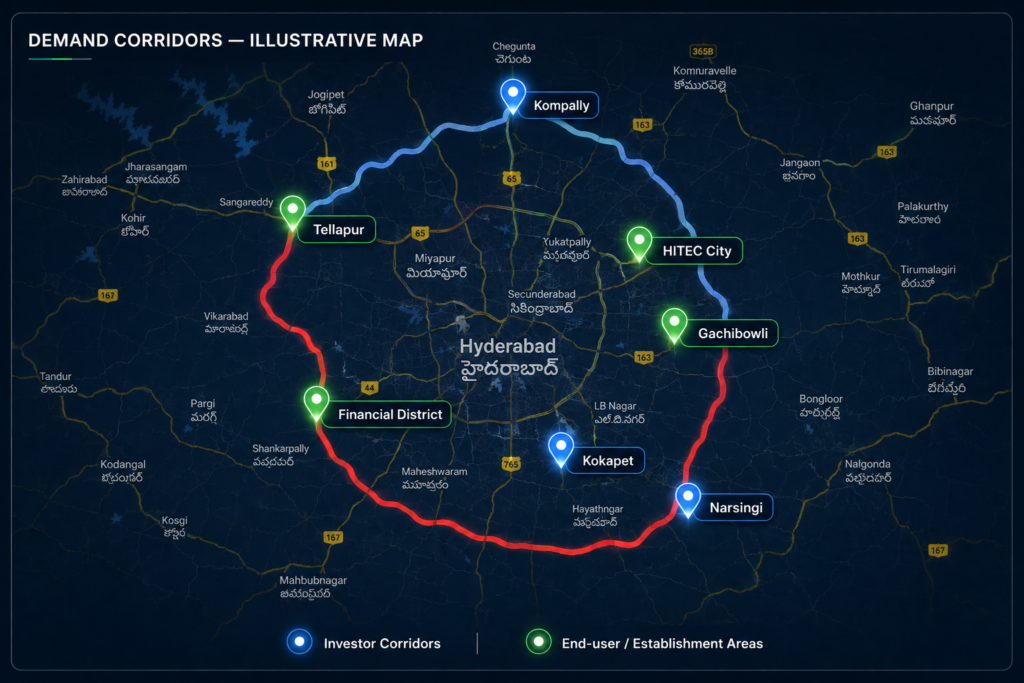
Hyderabad's growth corridors attract two distinct buyer types, and treating them identically is one of the most common marketing mistakes in this market.
NRI buyers represent a meaningful share of Hyderabad's premium and luxury segment, and they require an almost entirely digital-first buying journey, since a physical site visit before booking often isn't possible.
Most agency websites present services as a menu: SEO, ads, social media, branding, pick what you need. This is a poor way to think about real estate marketing, because these disciplines aren't independent — each one either feeds or depends on the others.

Every developer operates two brand layers, and confusing them is a common source of wasted marketing spend. The developer brand is the umbrella — the track record, reputation, and trust a company builds across every project it delivers. The project brand is specific to a single launch — its name, positioning, and identity, which typically has a shorter, more intense marketing lifecycle tied to the sales timeline.
A strong developer brand reduces the cost of marketing every individual project launch that follows, because buyers arrive with some baseline trust already established. This is why developer branding is foundational work, not a "nice to have" layered on top of project marketing.
A developer's main website should function as a long-term authority asset — the place that builds organic search visibility over years and houses the full portfolio. Individual project launches, however, are usually better served by a dedicated microsite or landing page: a focused environment without the distraction of other projects, optimised purely around lead capture and campaign-specific messaging.
The mistake to avoid is treating these as interchangeable — sending paid launch traffic to a general corporate website typically produces a measurably lower conversion rate than sending it to a page built specifically for that campaign.

AI Search Optimisation is the newest and most overlooked layer. Buyers increasingly ask AI tools — Google's AI Overviews, ChatGPT, Gemini, Perplexity — direct questions and receive a synthesised answer rather than a list of links. Getting cited inside these answers requires content structured to be extractable: direct, well-supported answers near the top of a section, clear entities, and genuine expertise rather than marketing language.

Meta Ads work well for awareness and retargeting, particularly for lifestyle-driven storytelling. YouTube Ads support video-heavy content — walkthroughs, drone footage, developer credibility pieces. LinkedIn Advertising is the outlier that matters specifically for commercial and office-space projects, where the buying decision sits with corporate real estate managers rather than individual consumers.

This content also does double duty: the same assets that convert leads also perform well organically on YouTube and social platforms, extending reach beyond paid distribution.

A lead who receives a useful locality infrastructure update six weeks after their first enquiry is far more likely to book a site visit than one who receives nothing until a discount announcement.

A lead becomes valuable only when it's managed effectively. By combining CRM integration, lead scoring, WhatsApp automation, and AI-powered qualification, we organize enquiries, identify high-intent buyers, automate timely follow-ups, and help your sales team focus on prospects most likely to convert into site visits and bookings.

Conversion rate optimisation on landing pages and forms compounds the value of every rupee already being spent on traffic. Reputation management matters more in real estate than most industries, because a prospective buyer will almost always check reviews before contacting sales.
The ecosystem above applies universally, but the emphasis within it shifts meaningfully by project type.

Villa Communities
Marketing leans toward high-production video, drone content that showcases the community and green space, and a slower, relationship-driven sales process — often supported by invitation-style events. Paid spend prioritises Meta and YouTube for brand storytelling over aggressive search-based lead generation.
Apartment Projects
Particularly in the mid-market and affordable-premium tiers, this depends more heavily on Google Ads for high-intent search, structured nurture sequences, and consistent Local SEO visibility, since buyers are actively comparing multiple projects on price and specification.
Commercial & Office
The buyer is a business, the decision-maker is often a facilities or real estate manager, and the sales cycle can extend to many months involving multiple stakeholders. LinkedIn Advertising and outreach-supported content — case studies, floor plate specifications, connectivity data — do more work here.
Land Sales
Marketing centres on appreciation data, infrastructure development timelines (Outer Ring Road access, Metro extension plans), and legal clarity content, since land purchases carry higher due-diligence expectations than a built unit with RERA registration in place.
Expectation-setting matters more in real estate marketing than almost any other industry, because different parts of the system mature at different speeds.
Months
Months
Months
CiberFlo builds real estate marketing around this ecosystem, not around isolated services sold individually. That distinction matters practically: a landing page built without CRM integration in mind creates a data gap later; a paid campaign built without a nurture sequence behind it wastes a share of every lead it generates.
Working across both the Indian and Australian markets has reinforced a particular discipline around measurement and reporting — real estate clients see exactly what a lead cost, where it came from, and how it moved through to a site visit or booking, rather than a summary of impressions and clicks.
Full-ecosystem approach — including the CRM, nurturing, and AI automation layer most agencies leave out.
Genuine Hyderabad market fluency — corridor-level understanding, not generic city-wide targeting.
Education and transparency first — so you can make an informed decision about a partner, not just a purchase.
Cross-market discipline — measurement and reporting standards carried over from working across Indian and Australian markets.
It depends on project type and buyer segment - Google Ads and Local SEO for high-intent apartment searches, Meta and YouTube for lifestyle-driven villa marketing, LinkedIn for commercial and office projects. The project-type section above breaks this down further.
Significant - Hyderabad buyers typically search by locality rather than by city, so visibility for "apartments in Kokapet" or "villas near Gachibowli" matters more than generic city-wide keywords.
Through a combination of landing page qualification questions, CRM-based lead scoring, and automated qualification via WhatsApp or AI agents before a lead reaches a sales conversation - described in more detail in the ecosystem section above.
This gap is closed through structured nurturing - timely WhatsApp follow-up, useful content over time, and CRM-tracked engagement - rather than left to sales teams calling repeatedly with no supporting system.
Through metrics tied to actual business outcomes - cost per qualified lead, site-visit conversion rate, booking conversion rate - rather than impressions or raw lead counts alone.
An approach built around the full ecosystem - including the CRM, nurturing, and AI automation layer most agencies leave out - combined with genuine Hyderabad market fluency rather than generic city-wide targeting.
It's the practice of structuring content so AI tools like Google's AI Overviews, ChatGPT, and Perplexity can extract and cite it directly when buyers ask research questions conversationally - an emerging and currently underused opportunity in Hyderabad real estate marketing.
Whether you're preparing a new project launch, trying to improve lead quality on an existing campaign, or building a marketing system for the first time, the next step is a conversation about your specific project — not a generic proposal.